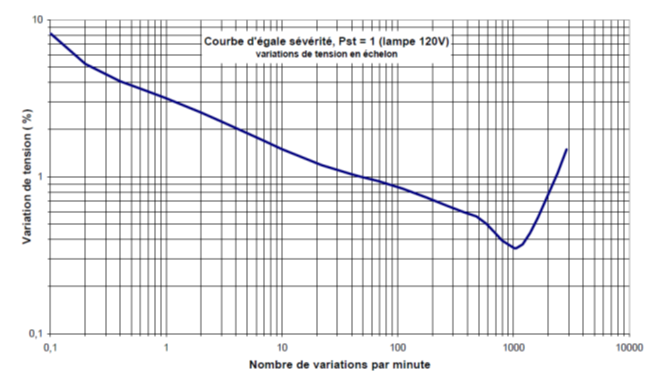
The start-up or operation of certain electrical machines, particularly motors, can cause voltage fluctuations in the electrical wave, which in turn can cause fluctuations in the light intensity of lamps powered by this electrical wave. This phenomenon is called “flicker.” Above a certain amplitude, this will cause discomfort to people exposed to these light fluctuations. The discomfort threshold will be lower as the frequency of the fluctuations increases.
In addition to motors, equipment such as arc furnaces and welding machines are also likely to cause flicker.
Flicker is quantified by two parameters: the short-term flicker level (Pst), which quantifies the phenomenon over 10-minute measurement windows, and the long-term flicker level (Plt), which quantifies it over 2-hour windows. Plt is calculated from Pst measurements. These parameters were established by the International Electrotechnical Commission (IEC) in their standard IEC/TR 61000-3-7. This standard was adopted by the Canadian Standards Association under the number CAN/CSA-IEC 61000-4-15:03.
These standards set the reference value for Pst at 1 when the threshold probability of complaints from people exposed to this level of flicker is reached. This sensitivity threshold was established experimentally according to different fluctuation frequencies. This made it possible to establish a curve of equal severity, with all points representing a Pst = 1.
For an industrial facility, this flicker assessment takes into account all motor loads of 15 HP and above, according to Hydro-Québec recommendations, welding stations, arc furnaces, and lighting, as well as their respective start-up frequencies. Other parameters, such as the shape of the fluctuation (ramp, step, etc.), are also considered. This will make it possible to establish the expected flicker level for this installation. The result obtained must comply with the limit allocated by Hydro-Québec.
3E Ing., with its team of experts, was commissioned to conduct this study to assess the level of flickering for the future wood planing mill. The 3E Ing. team successfully carried out the following activities:
- Verification, correction, and updating of the list of loads and their characteristics in accordance with the single-line diagram of the future plant;
- Selection of the appropriate calculation and assessment methodology based on the four methods proposed by Hydro-Québec’s C.22-03 standard;
- Use of Hydro-Québec data required for the study’s calculations, including short-circuit power and the X/R ratio of the MV network;
- Calculation of long- and short-term emissions (Plt and Pst) and verification of their compliance with the limits allocated by Hydro-Québec;
- Implementation and deployment of quality assurance activities;
- Production of the study report in accordance with best practices and presentation of the final results.